 The subject being dealt with here is complex, and a thorough treatment could easily turn into a large book. This is not our intention; therefore, we will be brief and not cover all relevant Scripture passages. Much of it is related to a distortion of dispensational theology, which is dealt with more directly in our article Ruckman’s Variable Salvation Dispensationalism.
For all practical purposes, salvation has always been the same. We would concede that salvation was different in the Old Testament in some small technicalities, such as them having a more limited knowledge of Christ and looking forward to his redemptive work, but the basic elements of faith, grace, and repentance have always remained the same. Salvation since Old Testament times involves a more complete knowledge of Christ (such as specific details about his death, burial, and resurrection), something for which Old Testament saints would not have been held responsible. Luke 12:48 tells us, For unto whomsoever much is given, of him shall be much required...
Peter Ruckman does teach salvation by grace in the current church age, but for other periods it is a different matter. Here is a representative quote that summarizes his views:
The original “plan of salvation” was pure WORKS (Gen. 2:16-17), and in the Millennium the last plan of salvation is again pure WORKS (Rev. 22:14), contrary to every immature, milksop, Baptist baby in your town or city. Genesis 3:22 corrects the kiddies. (Ruckman, Peter. Ruckman’s Bible References: Personal Notes on Salient Verses in the Bible. p. 7)
For the Old Testament, Ruckman has an erratic system with the method of salvation switching back and forth in an attempt to deal with some theological difficulties. Notice the following:
In the Old Testament, you find salvation before the Law by grace through faith and under the Law by faith and works… (Ruckman, Peter. Body, Soul, and Spirit. 1986, 1997, p. 12)
Ruckman does bring up the fact that the teaching of salvation plus works had been more prevalent earlier in the church age. However, what is unusual is someone who believes in salvation with no works during the current dispensation but also believes that works were involved in previous dispensations in addition to it being involved after the rapture. Notice Ruckman’s instructions for those left behind after the rapture in his odd tract Millions Disappear:
2. Start working your way to heaven.–
If the Lord comes and you remain behind, then start working like a madman to get to heaven, because you’re going to have to. You have entered a period of time called “The Great Tribulation,” and the plan of salvation in the Tribulation is faith in Jesus Christ plus your own good works. (Ruckman, Peter. Millions Disappear. 1989, p. 23)Before the Rapture, you could have been saved by grace through faith plus nothing (Ephesians 2:8-9), but one minute after the Rapture took place you must get out the Ten Commandments and the Golden Rule and start learning them, because you’re going to be judged by them (Matthew 25:31-46). (Ruckman, Peter. Millions Disappear. 1989, p. 23)
It will take faith in Christ’s shed blood, plus works—exactly as in the OT it took faith in shed blood and works. (Ruckman, Peter. Millions Disappear. 1989, p. 26)
Ruckman’s system of different plans of salvation for different ages is so bizarre that he teaches no less than six different plans of salvation in the book of Acts alone:
E. “The book of Acts consistently presents the same keys, the same plan of salvation.”
It does if you are as blind as blind Bartimaeus on a weekend drunk—just as blind as a bat backing into a blizzard. There are SIX “plans of salvation” in the book of Acts, as God continued to reveal more light on “the gospel of the grace of God” (Acts 20:24) (which was not revealed to Peter; it was revealed to Paul—Gal. 1, 2). Peter himself testifies to Paul’s “plan of salvation” in Acts 15:11. Read it. I said, “Read it.” Read it or shut your big, tongue-wagging blabber mouth.
1. Salvation by repentance and water baptism with NO tongues as evidence in a single convert (Acts 2:38).
2. Salvation by belief and water baptism without any convert speaking in tongues (Acts 8:12).
3. Salvation by grace through faith before water baptism or tongues (Acts 10:44).
4. Salvation by grace through faith after water baptism (Acts 19:2–6).
5. Salvation by belief and baptism without getting the Holy Spirit (Acts 8:16).
6. Salvation by grace through faith without tongues or water baptism (Acts 8:37) and without tongues or laying on of hands (Acts 8:38). (Bible Believers’ Bulletin. Jan. 2007, p. 16)
Could you imagine the confusion inherent with six different plans of salvation during the short period covered in the book of Acts? This paints a whole different picture compared to the God of the Scriptures, who is described therein as “not the author of confusion” (1 Cor. 14:33).
The confusion in Ruckman’s system is not restricted to the book of Acts, as he admits that “Under the Mosaic Law, ‘salvation’ is such a shifty, indefinite thing…” (Ruckman, Peter. How to Teach Dispensational Truth. 1996, p. 53)
Ruckman’s beliefs regarding Old Testament salvation are so inconsistent that he regularly has to make exceptions to his own rules. Romans 4:6 is very clear in stating that God imputed David’s righteousness “without works.” As for Abraham, notice verses two and three in the same chapter: For if Abraham were justified by works, he hath whereof to glory; but not before God. For what saith the scripture? Abraham believed God, and it was counted unto him for righteousness. Notice also Genesis 15:6: And he believed in the LORD; and he counted it to him for righteousness. Now observe how Ruckman has to make a special exception for them:
The two ruses resorted to are to refer to Abraham, who was NOT under the Law, and David (Isa. 55:3; Rom 4:6; Acts 13:34), who was a chosen exception to the Law. (Ruckman, Peter. Bible Believers’ Bulletin Reprint Vol. 3 “Doctrinal Studies.” 2000, p. 324)
The fact that Ruckman had to make multiple exceptions to his rules throughout the Old Testament period indicates the weakness of his position.
Because Ruckman teaches salvation by grace through faith in the current church age, some statements he makes referring to this age reveal the impossibility of his position as applied to other ages. In Theological Studies. vol. 23, p. 9, he affirms that “grace is not works, and works is not grace,” however in the plan of salvation he makes up for Moses, he mixes both together: “Salvation is by grace, through FAITH and WORKS.” (Ruckman, Peter. How to Teach Dispensational Truth. Pensacola, FL: Bible Baptist Bookstore, 1996, p. 98). Romans 11:6 refutes Ruckman outright: “And if by grace, then is it no more of works: otherwise grace is no more grace. But if it be of works, then is it no more grace: otherwise work is no more work.”
Here is another contradiction. Keep in mind that Ruckman combines faith and works, and faith involves belief: “Belief is the opposite of works (Romans 4:5), and believing is what you do when you don’t work (Romans 4:5).” (Ruckman, Peter. The Book of Acts. 1974, 1984, p. 471)
How were Old Testament saints saved? The Bible does answer the question for us, invalidating any contrary speculation. The clearest passage is the entire chapter of Hebrews 11. A single verse that sums it up nicely is found in Acts 10:43:
To him give all the prophets witness, that through his name whosoever believeth in him shall receive remission of sins. The following passage also answers the question: Of which salvation the prophets have enquired and searched diligently, who prophesied of the grace that should come unto you: Searching what, or what manner of time the Spirit of Christ which was in them did signify, when it testified beforehand the sufferings of Christ, and the glory that should follow. Unto whom it was revealed, that not unto themselves, but unto us they did minister the things, which are now reported unto you by them that have preached the gospel unto you with the Holy Ghost sent down from heaven; which things the angels desire to look into. 1 Peter 1:10-12.
Referring to Isaiah’s time, Paul assures us in Romans 10:16-19 that Israel had heard the Gospel and that they knew about it: But they have not all obeyed the gospel. For Esaias saith, Lord, who hath believed our report? So then faith cometh by hearing, and hearing by the word of God. But I say, Have they not heard? Yes verily, their sound went into all the earth, and their words unto the ends of the world. But I say, Did not Israel know?
Ruckman is very quick to insult Baptists and other sound teachers who do not go along with his views in this area with his characteristic abrasive style:
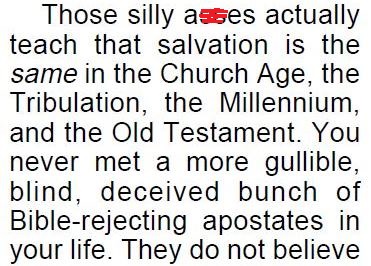
Those silly a**es actually teach that salvation is the same in the Church Age, the Tribulation, the Millennium, and the Old Testament. You never met a more gullible, blind, deceived bunch of Bible-rejecting apostates in your life. They do not believe one verse in the Holy Bible (AV 1611) if it offends them or if it is incomprehensible to their cloned, programmed, isolated mentalities. (Bible Believers’ Bulletin. Nov. 2001, p. 13)
A Baptist who teaches that Old Testament salvation before (and under) the Law and Tribulation salvation and Millennial salvation are identical to New Testament salvation is, by any set of Scriptures quoted from any translation of any version of the Bible, a viable heretic. He has denied three-fourths of the Scriptures at one lick…how do these pitiful, Bible-perverting Baptists alibi their sin? (Ruckman, Peter. Bible Believers’ Bulletin Reprint Vol. 3 “Doctrinal Studies.” 2000, p. 269)
Not only does he call them apostates, he does not hesitate to use the term “heretic” for those who teach that in the Old Testament saints were saved by looking forward to the cross:
Whenever you hear any heretic say that “men are saved in the Old Testament by looking forward to the cross and after the New Testament by looking back at the cross,” you are dealing either with a lazy preacher or a stupid preacher or a crooked, lying fool. (Bible Believers’ Bulletin. April 2004, p. 18)
Notice carefully Acts 26:22-23, which informs us that Moses and the prophets foretold believers of their day concerning the coming and work of Christ, which gives credence to the adage about those in the Old Testament looking forward to the cross:
Having therefore obtained help of God, I continue unto this day, witnessing both to small and great, saying none other things than those which the prophets and Moses did say should come: That Christ should suffer, and that he should be the first that should rise from the dead, and should shew light unto the people, and to the Gentiles. (Acts 26:22-23)
It seems Ruckman tries to be very careful with what he says about the sufficiency of Christ’s sacrifice and man’s current inability to perform enough good works to merit salvation, likely because he believes men in certain periods could/will be saved by works. For example, his commentaries under Ephesians 2:8-9 and Titus 3:5 (well-known clear passages refuting works salvation) have little to say about the matter except how the passages refute the major cults. However, in the series Theological Studies, in which he heavily plagiarized from Alban Douglas’s work One Hundred Bible Lessons (see Is this plagiarism?), Ruckman lets his guard down. Notice this statement:
Every man and woman who is counting on their righteousness to save them has pitted their righteousness against the righteousness of God…Do you know what you have said to God? You have said to God, “I know that Christ is the end of the law for righteousness to everyone that believeth, but personally I think that prayer and good deeds can make me just as good as Jesus Christ.” …when Christ made that payment for sin on Calvary’s cross, that payment extended from before Genesis 1:1 until after Revelation 22. (Ruckman, Peter. Theological Studies. booklet 10, pp. 7-8)
How does the above square with Ruckman’s belief in works salvation during approximately two-thirds of the time man has been on earth? Was man any different in the past? Was man previously capable of pitting their righteousness against the righteousness of God? Will mankind after the rapture be capable of pitting their righteousness against God, and suddenly be capable of meriting salvation by their own good deeds? Ruckman can’t have it both ways. When an unbiased person attempts to apply Ruckman’s teachings consistently, he quickly sees that his theological system is full of holes and falls apart very quickly.
We don’t claim that Ruckman completely originated the view that Old Testament saints were saved by works, but some Ruckmanites have portrayed C. I. Scofield of holding this view in an attempt to add some respectability to Ruckman’s position. Admittedly, there are a couple of quotes from the first edition of Scofield’s Reference Bible that, in isolation, give the impression that Scofield held to Ruckman’s view on this matter. To look further into the issue, we located two of Scofield’s books, and we gleaned the following quotes, which reveal views incompatible with salvation by works at any time:
If a soul seeks salvation by good works, the works must be performed. And this is why the law can only condemn; for, besides Jesus, no man ever kept the law. (Scofield, Cyrus. In Many Pulpits. New York: Oxford University Press, 1922, p. 129)
But the emphasis of this lesson [Isaiah 55] certainly falls on the freeness of Gospel salvation. There is absolutely nothing to apply. Any “Gospel” that leaves one single atom of salvation to be wrought out by the sinner is that “other” Gospel upon the preaching of which rests the solemn anathema of God (Gal. 1:6-9). (Scofield, Cyrus. Things New and Old. New York: Publication Office Our Hope, 1920, p. 12)
If there remains any doubt about Scofield’s position, the reader should read the chapter “The Walk of Faith” (pp. 301-307) in Scofield’s Things New and Old book. In this chapter he deals with the faith of Old Testament saints, drawing from Hebrews 11.
A thorough treatment of James 2:14-26 on the topic at hand could turn into a whole book. But it deserves to be dealt with at least briefly. James chapter two is not speaking of meritorious works, but rather of works in the sense of evidence of salvation that is visible to others. James 2 is not about earning but about proving. Works is often brought up in the Scriptures as evidence:
If I do not the works of my Father, believe me not. (John 10:37)
They profess that they know God; but in works they deny him, being abominable, and disobedient, and unto every good work reprobate. (Titus 1:16)
Much (if not all) of James chapter two is talking about being justified in the eyes of men by our works, not righteousness before God or self-merit. Verse 18 refers to “showing” twice. If you have faith, it will show in your works. Man is unable to see the heart as God can. Compared to God, we are handicapped because we can only see what is on the outside, which is works. God does not have this handicap. …for the LORD seeth not as man seeth; for man looketh on the outward appearance, but the LORD looketh on the heart (1 Sam. 16:7).
In summary, works are brought up in James 2 as evidence of faith, not the initial act of being set right with God as when one is born again. Holding to the old biblical adage that “We don’t work to get saved, we don’t work to stay saved, we work because we are saved” is helpful when studying this passage.
Is Ruckman the first dispensational writer to ever teach that salvation during the tribulation can only be obtained through works? Ruckman apparently thinks so, as in the following documentation he seems to give himself credit for teaching this for the first time, as the date he lists is around the time he graduated with a doctorate from BJU:
This means that in the Tribulation, you can lose it! [his salvation] … the truth that I’m talking about right now—taught first in 1954—is unknown to Pre-Millennial scholars. (Ruckman, Peter. The Book of Revelation. Pensacola, 1970, 1982, p. 413)
Could it be that some aspects of Ruckman’s teachings of different plans of salvation for different ages were motivated by a desire to make a name for himself? We may never know for sure, but the way he brings up the matter, that he believes salvation by works in the tribulation was unknown and untaught before his time, not to mention the way he demonizes those who teach that Old Testament saints were saved by grace, is cause for suspicion. The fact that some aspects of Ruckman’s multiple plans of salvation are new teachings (something Ruckman does not deny), plus other odd teachings such as “the KJV corrects the Greek,” warrants placing a label on such a theological anomaly. When a group responsible for new teachings does not name themselves differently (i.e., Ruckman continuing to call himself a Baptist), it is proper and in line with church history to invent a name for new or unusual teachings. It is not uncommon for a name to be given based on the person who was responsible for popularizing a new belief. This is why the strange teachings of Peter Ruckman have been referred to as Ruckmanism since the 1970s.
In conclusion, we offer the following brief outline to demonstrate the unscriptural nature of Ruckman’s beliefs regarding this matter:
- Switching back and forth between plans of salvation that are opposite to one another would be against God’s nature (Mal. 3:6).
- Six plans of salvation during a short time frame in Acts would portray God as the author of confusion, which he is not (1 Cor. 14:33).
- At no time could a combination of grace and works constitute salvation, as they are terms that are contradictory to one another (Eph. 2:8-9).
- Abraham and David were examples of Old Testament saints, and not exceptions to the plan of God for salvation (Heb. 11:1-33).
- God declared Christ’s righteousness for the remission of sins that are past, which would naturally allow the sins of Old Testament saints to be remitted (Rom. 3:25).
- Christ offered himself as a sacrifice once and for all and ever lives to make intercession for us, invalidating the need for any other means of salvation in the future (Heb. 7:25-27).
- Although OT saints did not have complete knowledge of it, in God’s eyes Christ’s blood was shed before the foundation of the world (1 Pet. 1:19-20). Salvation has always been based on His shed blood, the Lamb slain before the foundation of the world (Rev. 13:8).
- Although some isolated verses may appear to teach salvation by works in the Old Testament, one of the most basic rules of Bible hermeneutics is to interpret individual verses in the light of the entire Bible, comparing Scripture with Scripture (1 Cor. 2:13).
- If salvation could be achieved by observing the law, then it follows that Christ foolishly died for nothing, according to Gal. 2:21: “I do not frustrate the grace of God: for if righteousness come by the law, then Christ is dead in vain.”
If you seriously believe that people after the rapture are saved by faith only, like they are in the church age… your going to have a hard time with Rev 14:12, along with others, that talks about “keeping the commandments” and the faith of Jesus. Unless your going to attempt to wrest the scriptures like so many of mainline christendom does today. You would be well advised to believe what God is telling you and stop twisting His words to fit your heresies.
Matt 24:13… which is discussing the tribulation period, says that a person must “endure unto the end” (works), in order to be saved. Paul never says anything about a christian having to endure unto the end in order to be saved. We are already sealed by that holy spirit of promise. (Eph 1:13). You as a bible-believer ought to know that things that are different, are not the same. You have not learned to “rightly divide” your scriptures.
Certainly the entire Bible is for us… but when it comes to church age doctrine… you need to stick with the apostle to the gentiles, Paul. You have proven with your own words, that your not ready for the other books and their doctrines yet.
Rev. 14:12 says: “Here is the patience of the saints: here are they that keep the commandments of God, and the faith of Jesus.”
That verse is not a problem in the light of the context of the whole of Scripture. For example, 1 John chapters 2-5 have a lot to say about keeping the commandments of God, and it is not talking about after the rapture. If you would be consistent with your interpretation of Rev. 14:12, you would have to say that based on 1 John we are saved by keeping the commandments even now. We are commanded to keep his commandments, but being human we fail. But as a blood-bought Christian, our sin is covered by the blood.
As for Mat. 24:13, I believe the context seems to indicate it is speaking of salvation of the flesh, not the soul. In other words, being rescued from physical desctruction. Verse 22 speaks in the following terms: “And except those days should be shortened, there should no flesh be saved…” The chapter has a lot to say about protecting yourself physically. You are trying to make it salvation of the soul, when the context is referring to saving your life in the physical sense.
I have not ignored the verses you brought up, but in turn you have ignored the verses I listed in the article that demonstrate that the context of Scripture is against your belief. Your belief was invented by Ruckman and first taught by him in the 1950’s according to Ruckman himself as I documented in this article.
Amen brother!
Amen! Salvation is the same in all Bible dispensations, from Genesis to Revelation. The “Hall of faith” in Hebrews 11:1-33 is a perfect example of how the Old Testament saints were saved, though they all died before they received the “promise”. Their “works” PROVED their faith…as James states:
James 2:14 What doth it profit, my brethren, though a man say he hath faith, and have not works? can faith save him?
James 2:15 If a brother or sister be naked, and destitute of daily food,
James 2:16 And one of you say unto them, Depart in peace, be ye warmed and filled; notwithstanding ye give them not those things which are needful to the body; what doth it profit?
James 2:17 Even so faith, if it hath not works, is dead, being alone.
James 2:18 Yea, a man may say, Thou hast faith, and I have works: shew me thy faith without thy works, and I will shew thee my faith by my works.
James 2:19 Thou believest that there is one God; thou doest well: the devils also believe, and tremble.
James 2:20 But wilt thou know, O vain man, that faith without works is dead?
James 2:21 Was not Abraham our father justified by works, when he had offered Isaac his son upon the altar?
James 2:22 Seest thou how faith wrought with his works, and by works was faith made perfect?
James 2:23 And the scripture was fulfilled which saith, Abraham believed God, and it was imputed unto him for righteousness: and he was called the Friend of God.
James 2:24 Ye see then how that by works a man is justified, and not by faith only.
There is no Scripture which teaches that anyone is saved by “the works of the Law” Biblical works are ALWAYS the result/proof of an already existing faith.
If salvation is the same in all dispensations then were the Old Testament saints born again? Were they in Christ and Christ in them? John 14:20 I do not agree with everything Dr. Ruckman teaches on this subject however, I think you have some serious issues to deal with when you say that salvation is the same in every age. The Church is the body of Christ and the spiritual union afforded to New Testament christians is unique to the Church. Salvation is always a result of God’s mercy and grace and it is always afforded by faith. That does not mean that OT salvation and NT salvation are equal. Show me the New Birth in the OT or the permanent indwelling of the Spirit in the OT. Both of those are essential parts of NT salvation and if salvation is the same in the OT then you have to explain why these were not present in the OT.
Doug Lay, what do you suppose was the reason Jesus descended into Paradise to see the OT saints? Everyone saved in the OT were born again. Do a throughal study of God’s covenant with Abraham and the covenant of circumcision of the heart. This circumcision of the heart is performed by the Spirit who gives us a new heart. There is another more familiar name for this: “born again.” Being born again of the Spirit is the same thing as having a circumcised heart, a new heart of flesh. Real circumcision is the same thing as being born again. Study the OT circumcision.
Amen. Well said Betty Dies.
Thank you for the reply Betty. I have studied Old Testament circumcision. It is a circumcision of the flesh. You are taking the New Testament concept of the circumcision of the heart (Rom 2:29) and reading it into the OT when its not there. Paul in Romans 2 makes a comparison with the physical circumcision of the OT and says a Jew is not a Jew who is one outwardly. Vs. 28 (Physical, outward, circumcision of the flesh). But a Jew is one who is a Jew inwardly. (Spiritual circumcision of the heart, born again). Nowhere did he say they were the same thing.
Where in the world do you get that OT saints were born again? You didn’t get that from the bible. No one was born again before the day of Pentecost. Jesus descended into Paradise and led the OT saints to heaven. They had been waiting in Abraham’s bosom (paradise) for the completion of their redemption. Until Christ was crucified, buried, rose and ascended to heaven the comforter could not come. John 16:7
The OT is the history of the kingdom of heaven; the NT is the history of the KOG
No one was born again in the OT, there is no eternal security under the OT, and no
saved sinner was called a son of God: The new birth is a NT phenomenon
Romans – Philemon is doctrinally applicable to all Christians
Your salvation is completely different from everybody else’s salvation
Be careful of transitional books…Born again is only new testament Old testament Saints were saved by faith and works..example Rahab ..Hebrews 11:31 [By faith ]the harlot Rahab perished not with them that believed not, when she had received the spies with peace. Now look at James who was it written to 12 Tribes Old testament…James 2:25 Likewise also was not Rahab the harlot justified by works, when she had received the messengers, and had sent them out another way?
What, do not you know Jesus used either term interchangably? Moreover, His use is to indicate a spiritual, not temporal, kingdom.
Pondering the similarity between the Russellite teaching of separating the kingdom of God from its counterpart, did Ruckman fetch his teaching from Watchtower literature?
There were saved people in the Old Testament who were called Sons of God. Check out Genesis 6. Sons of God were the rightful lineage of Seth (unless you subscribe to the false doctrine that it refers to fallen angels).
Nonsense, fallen evil angels are the sons of God , there was never no " godly line of Seth. The Bible NEVER mentions a "godly" line of Seth . Scofield add it in that was his THEORY. And most of all remember to rightly DIVIDE the Word of Truth. Or you gonna get swept away in foolish doctrine.
Your spirit is born again..John 3….not your heart jere 17:9…you can’t discuss doctrine without scripture
Have you never read Hebrews quoting the prophet Jeremiah? Here are some similar quotes as well from Ezekiel 11.19, 18.3 and 36.26.
And I will give them one heart, and I will put a new spirit within you; and I will take the stony heart out of their flesh, and will give them an heart of flesh: Cast away from you all your transgressions, whereby ye have transgressed; and make you a new heart and a new spirit: for why will ye die, O house of Israel? A new heart also will I give you, and a new spirit will I put within you: and I will take away the stony heart out of your flesh, and I will give you an heart of flesh.
I will not present many of my own convictions here. Arguing with Ruckmanists is like arguing with Mormons, Jehovah’s Witnesses, charismatics, etc. This doctrine is so firmly entrenched in them, not many of them are going to see the truth. Prayer is what works. If you know any of them personally, pray for them, that God’s Holy Spirit will open their eyes. I will say, “Thank God for this web page.”
The paragraph on this particular article, that begins, “How were the Old Testament saints saved?” gave me answers I have needed. I also want to say to Linda, “Thanks for your post. Well put.”
The encouragement of God’s word is, “Let every man be persuaded in his own mind.” I also want to give everyone this key: interpret the Bible as if it were one long sentence. It is God’s Word, not just God’s words. It is to be interpreted that way. One long continuous thought. Do not interpret scripture on the basis of one verse, or even two or three verses. From the beginning to its end, it has one theme for man’s redemption, and only one: Acknowledge God as God. That means when you learn His commandment, or commandments, you will be obedient to them. Your faith in Him leads you to obedience. This acknowledging of Him, and placing faith in Him, hence being obedient to Him,
was what caused Old Testament saints to be able to have the best relationship that they could have in that dispensation, before or during the law. If someone broke the law, the principle is exactly the
same. But NOW that acknowledging of who He is would lead them to Repent. In the giving of the law are commands for what they are to do to demonstrate their REPENTANCE. But it was the repentance God was looking for first, then the sacrifice. These people could not have possibly known that the purpose of the feasts, sacrifices, tabernacle and its furniture, etc. was to ultimately portray Christ. And the didn’t need to. All that was required, if you acknowledge God as God, is that you be obedient. Obedient to all parts of the law: when you’re doing right, as well as when you sin against God and his law. The DOING of the law did nothing for anyone. Scripture tells us of those times when the Jews were keeping the law, but it was all a show. They were not acknowledging God for Who He is (was).
Those who loved God and died, were sent to what Christ was pleased to call Paradise. There they wait, until a crucified Christ goes to the heart of the earth, and tell them of the sacrifice He has made, which naturally they rejoice in, and He takes them all to heaven. The program during the life of Christ was the same: acknowledge God for who He is, as is taught by He who claims to be the Christ. Once you realize you have broken His law you REPENT, exactly as the prophets preached. That did not change at all. The preaching of John the Baptist was simply REPENT; nothing added, but something is being taken away: the law. Salvation came to Zaccheus’ house (one example out of many) simply because Jesus saw in his heart one feature, repentance. He made that statement to him BEFORE Zaccheus had a chance to carry out his vows to make things right, not after. God only seeks a repentant heart. After the death of Christ, something new is added. Because it is impossible for us to keep the law, we put our faith in the only one who could keep the law: Christ. Acts 20:21 sums it up so beautifully – “REPENTANCE (there’s the key) toward God, (because we’ve sinned; broken His law) and FAITH in the Lord Jesus Christ.” Why the faith? Faith that Jesus really can and has washed our sins away, and that our salvation is eternal, and we have a home in heaven. REPENTANCE is the key, all the way through the Bible.
Hello Good Day! I am so glad to receive those message from Word that need to enhance my christian life most especially the salvation that is free. I was asking for your favorable support to send me more detail of inspiring words from the Word of GOD….. Thanks a lot..God Bless..:-)
I could be wrong but I think E.W. Bullinger is the first to teach salvation by works in other dispensations. Which is obviously a major heresy.” He shall pray unto God, and he will be favourable unto him: and he shall see his face with joy: for he will render unto man his righteousness. He looketh upon men, and if any say, I have sinned, and perverted that which was right, and it profited me not; He will deliver his soul from going into the pit, and his life shall see the light. Lo, all these things worketh God oftentimes with man, To bring back his soul from the pit, to be enlightened with the light of the living. Mark well, O Job, hearken unto me: hold thy peace, and I will speak. If thou hast any thing to say, answer me: speak, for I desire to justify thee.” (Job 33:26-32 KJV)
I have always believed that salvation was the same all through the Bible because I was stupid enough and gullible enough to believe what I was taught. Since I began to search the Scriptures I have realized that the Scripture does teach different plans of salvation for different groups of people. To use Malachi 3:6 to say that God cannot have different plans of salvation at different times is pure nonsense. That is a classic example of man dictating to God what He can or can’t do. I challenge you to read Luke 1:6 and prayerfully answer these questions. Were Zacharias and Elisabeth righteous before God? How were they righteous before God? If you believe what the Bible says, you will see that it was through walking in the commandments and ordinances of the Lord blameless. That is not how I stand righteous before God. That is not obscure but plain.
A reply to Visitor. You said, “Were Zacharias and Elisabeth righteous before God? How were they righteous before God? If you believe what the Bible says, you will see that it was through walking in the commandments and ordinances of the Lord blameless.” There has NEVER been ANYONE that is or has been “blameless”. Not even Zacharias and Elisabeth. Nicodemus, the one Jesus told he had to be born again, was under the OT Law. By Faith he was saved. Jesus hadn’t went to the cross yet. Luke 2:30 “And, behold, there was a man in Jerusalem, whose name was Simeon; and the same man was just and devout, waiting for the consolation of Israel: and the Holy Ghost was upon him. And it was revealed unto him by the Holy Ghost, that he should not see death, before he had seen the Lord’s Christ. And he came by the Spirit into the temple: and when the parents brought in the child Jesus, to do for him after the custom of the law, Then took he him up in his arms, and blessed God, and said,
Lord, now lettest thou thy servant depart in peace, according to thy word: For mine eyes have seen thy salvation, Which thou hast prepared before the face of all people; A light to lighten the Gentiles, and the glory of thy people Israel.” By Faith Simeon, under the OT Law, was saved by Faith. All OT Saints were saved by Faith and held in a ‘holding place called Abraham’s Bosom until the resurrection. Their Faith was counded as righteousness which means “right standing before God.
Buddy, if you’re not walking in the commandments of God – you’re not righteous.
“Little children, let no man deceive you: he that doeth righteousness is righteous, even as he is righteous.”
1 John 3:7
You’re not made righteous by keeping the commandments. You’re made righteous through the sactification by the Blood and the work of the Holy Spirit convicting you of your sin and leading you to repentance. The born again believer is continually conscious of walking in the commandments of God. He/she will make mistakes but they are *mistakes* and not the normal behaviour of that born again believer.
Anyone who thinks they’re saved just because they made some confession of faith at an evangelical meeting somewhere is deluding themselves. You must be circumcised in the heart. Born again. Dead to sin. Alive in the Spirit of Christ. Wondering homeless in this world. Despising the desires of the flesh. Not wanting to touch even the garments of the unregenerate filth of this world ruled by Satan. Longing for the return of Jesus Christ so that you and all that are His can be delivered from this wicked generation. If none of this rings true to you it is time to consider whether or not you are born again.
“Ye adulterers and adulteresses, know ye not that the friendship of the world is enmity with God? whosoever therefore will be a friend of the world is the enemy of God.” James 4:4
I left a church over the teaching of this false heresy and due to discrimination (for God loves black folk, too.) I thank God for this expose and I do think praying for those locked into such a confusion is in order. I thank God for this website and may the warriors with the guts to go to battle for the truth behind this site stand strong, be encouraged, and continue to be a bearer of the light of the truth of the living God. Amen.
P.S. I serve a God who changes not. He said in His Word that their is none righteous, no not one. I know He changes not, so He is not changing His mind on that statement. I couldn’t work my way into heaven if I tried, as my righteousness is as fillthy rags. This is in the Bible Ruckman supposedly defends. If God said it, and He changes not, and that is supposed to settle it, then what was the question again ?
We used to call the ones that believed baptism was equal to salvation “water dogs.” And we would joke that we could just get everybody out in the street under a fire hose and all the world could be saved. What is so disturbing about the teaching of many ways of salvation is that it takes away from the work of preaching the true Gospel of Jesus Christ in this age. It is as just as confusing as the doctrine of salvation by baptism alone. Some may be this confused about baptism salvation: (“I took a shower, does that mean I’m going to Heaven ?” Likewise, some may be this confused over Ruckman’s Heresies… “I did a good deed today. If works was a part of salvation one time before and will be again, maybe if I die tonight I did a good enough deed to get me there even though I haven’t believed by faith yet. “) This is a terribly confusing doctrine.I admit it causes confusion in the churches among Christians, but sadly, it can be salvation denying for the unsaved if they wallow in confusion too long.
I read a little excerpt from the tract “Millions disappear.” Ruckman states that one minute after the Rapture the persons are going to have to have faith and works. (My paraphrase.) I can just see the persons now who are left here. “Oh, you mean I gotta work to keep it ? Well, what’s the use in believing then. If my works are gonna be good enough anyhow, I think I’ll skip the whole faith part and just work on. Now where is that first step on the ladder to Heaven ?”
I pray for the persons who run this website, dear God. Bless them and all the persons who have posted comments that honor thy Word and Thy truth. Please keep the website going for others to find light in the darkness of teachings contrary to Thy Word and Thy light.Amen.
I have read about Peter ruckman.And study my Bible..He is absolutely right..Once your guys eyes open to the truth let me know
9:48 PM 6/29/2014.
Burn the incense, a little, this train is smoking hot!!!! That is how I get when I read about the doctrine that Ruckman puts forth, which is no doctrine really, that salvation was different in the old Testament.
My research for this rebuttal is not complete, but I must say, that is a lousy way to get people to believe in God. If Ruckman tries to explain to an unbeliever the differences in his interpetations, so that he tries to win persons to Christ, he has absolutely no rebuttal himself against those that think they are even now good enough to get into Heaven.
There used to be a commercial on television, that if Ray’s Kingburger were good enough for Richard Petty, the famous NASCAR driver, “…it is good enough for me.” So what apologetic can convince someone who thinks that if it were good enough for Adam and Eve and Abel, (not…see Hebrews ch. !!) and scores of other saints from the beginning of Creation until the cross of Christ (?) that works saves then “…its good enough for me, too.” Could it be that Ruckman went looking for a way to distinguish himself when his light among Baptists was dimming (if so, and it were for that reason he came up with the doctrine, then read that light dimming as popularity decreasing and wallet shrinking!)
The doctrine itself makes me so very angry because it denies the LORD. Not just what Jesus Christ did, who He is, and what the purpose of His passion was, but also it stands in the way of letting sinners know of God’s eternal love.
What does Ruckman do ? What does he do with the doctrine of the Lamb of God, slain from the foundation of the World ? What does he do ? What does Ruckman do with all of the saints that are mention in Hebrews 11 ? What ? Just because faith is mentioned less by the actual word in the Old Testament, that means there was less of it ? I don’t think so.
Paul lets us know, had the fallen angels knew, that would not have crucified the Lord of Glory. So doesn’t it make sense, since God waited until the fullness of times to reveal His Son, that the Old and New Testament has to be taken together on some things ? In what Ruckman does, his logic is that if it isn’t mentioned more than twice in the Old Testament by the word itself (see his teachings on the word faith) then it didn’t have importance.This divides the word to the extreme.
The biggest [rpb;em with Ruckman is that he teaches doctrines that divide, a man who makes divisions, we are to mark him and avoid him. Period.
Please disregard first post.
Rev 14:12 Here is the patience of the saints: here are they that keep the commandments of God, and the faith of Jesus. (Faith + Works)
Rev 1217 And the dragon was wroth with the woman, and went to make war with the remnant of her seed, which keep the commandments of God, and have the testimony of Jesus Christ. (Faith + Works)
Rev 20:12 And I saw the dead, small and great, stand before God; and the books were opened: and another book was opened, which is the book of life: and the dead were judged out of those things which were written in the books, according to their works. (Faith + Works)
Revelation 22:14 King James Version (KJV)
14 Blessed are they that do his commandments, that they may have right to the tree of life, and may enter in through the gates into the city. (Faith + Works)
If you don’t think that these verses are talking about faith + works in order for a Tribulation saint to be saved… then you are seriously misled and not obeying God’s commandment…
2 Timothy 2:15 King James Version (KJV)
15 Study to shew thyself approved unto God, a workman that needeth not to be ashamed, rightly dividing the word of truth.
In Rev. 12:14 the people are already saints. notice the semi-colon.the rest of the verse tells how the saints are walking their walk. THIS IS NOT A SALVATION PASSAGE. Please consider what isay. Rev 12:17. This chjapter has todo primarily with the nation of Israel during the tribulation. Note in these verses that the commandments of GOD come first, comma,then faith in Jesus. Let us identify the commandments the Apostle John is talking about. The commandments cannot be the Law for it was fulfilled in Christ. Col. 2:14, Rom. 10:4. there are zero verses in the Bible that say the law was reintroduced after it was nailed to the cross. John wrote the book of Rev. , so lets see how John uses the words commandment and works. In Jn. 7:19, Jesus said no one kept the law. How does a person do the works of GOD? Read Jn. 6:28,29. Jesus corrected them by say it was GOD who did the work. We need only believe. Tribulation saints- some teach they must endure to the end to be saved.this isn’t salvation from hell.(Matt 24:13) Not all saints endure the tribulation.They were killed and went to heaven. Rev. 6:9-11, 7:9-14. Verse 14 plainly states the got there by the BLOOD OF THE LAMB-NOT BY WORKS. Rev 20:12 is the judgement of the lost.their works determine their degree of punishment in hell. A Christians works (walking in the Spirit) determines their rewards. get info from more than one source and ask God to show you. He is faithful. sorry for the typos.
salvation in every dispensation is always by blood. study the doctrine of atonement jn both testaments.nicodemus, an old testament jew, was told by Jesus that he had to be born of the Spirit.O.T. regeneration was similar to N.T. SALVATION except the Spirit didn’t continually abide in the O.T. believer. Study Psalm 87, especially verses 5 and 6. I hope this helps. See also psalm 51 verses 9 and 10.
Ruckman applying Gen 2:16,17 to salvation is flat out error. Since when is not doing something called works? Adam and Eve weren’t in a fallen state until Gen 3 when they sinned. THEREFORE Gen 2:16,17 has nothing to do with separation from God whatsoever. In Gen 2:16 they were freely eating of every tree in the garden in a state of innocence. they didn’t need to be saved because they weren’t lost. Ruckman takes Gen 3:22 out of context. He should have read Gen 3:21 first. God shed the blood of an animal and clothed adam and eve with salvation in verse 21. Verse 22 has to do with living forever physically. Ruckman admits this on page 114 of his Genesis commentary.which I have. On page 111 of his commentary, He states Gen 3:15 does adam and eve no good at all.He Apparently he is just looking at it from a human perspective. as he states it is future. In GODS mind it is not future. Rev 13:8, Ephesians 1:4 . I think the flaw in ruckmans interpretation is that maybe he doesn’t take into account that god sees everything in the present tense.(Romans 4:17) Gen. 3:15 was a done deal in Gods and the (coats of skins) in verse 21 is a shadow or type of that promised redemption in verse 15. As far as Rev 22:14. the verse is talking about people who HAVE ALREADY BEEN SAVED. Chapter 22, Isee as occurring after the millennium. The HOLY SPIRIT reminds us how to be a part of Gods program in verse 17The water of life is the HOLY SPIRIT imparting the new birth to all who will believe in CHRIST. how do I know this-the BRIDEs message is JESUS CHRIST.(Rev22:21) I believe these are damnable heresies that deny the LORD and HIS ATONEMENT in all dispensations. 2 PETER 2:1
I find it difficult to understand how folks that believe nothing but faith in the shed blood of Jesus saves US today can inexplicably jump right over to a doctrine that says the blood of Christ alone was not sufficient for the OT saints, or the saints to come after the rapture. Its a form of Calvinism, and it is an insult to the cross to say Christ’s blood alone was not enough for ANYBODY that believed on him. “Abraham believed in the Lord, and it was accounted unto him for righteousness” Gen 15:6 (this was before any covenant)
I think folks that hold such a view spend too much time looking at differences in scripture instead of commonalities, similarities and common themes. It gives rise to all sorts of weird, divisive junk doctrines.
Paul is very clear on all his epistles that it has always been by God’s grace, through faith in the shed blood of Jesus. It was for Cain, For Noah, for Abram, for us, and for the saints to come. No personal pet interpretation of the scriptires will change that.
well said.
I’ve been looking for better answers for non-dispensationalist about OT saints not have eternal security as NT saints.
It’s apparent that NT saints was saved differently from the OT saints.
NT saints were sealed by the HS (Ep1:13) while the OT had the HS go in and out.
There are numerous scriptures that shows the Old Testament Saints were not sealed with the Holy Ghost. David feared the Holy Ghost being taken from him in Psalms 51:7-11. Samson lost the Holy Ghost in Judges 16:20, 28. In 1 Samuel 16:14, we see that Saul never found the Holy Ghost again. Therefore, the Old Testament Saints did not have the permanent indwelling of the Holy Ghost as the Church Age Saints do with the new birth.
dear honest seeker, you seem to be confusing eternal security with salvation. salvation is by blood . in the old testament God had to kill an animal in genesis 3:21 to clothe Adam and Eve. this was the first old testament picture or type of salvation. notice that the holy spirit is not even mentioned. in genesis 4:1-7, we have Abel offering a blood sacrifice of a lamb for his sins. God accepted that in verse 4. the lamb was a substitute until the promised redeemer should arrive. [gen. 3:15] I will give you one more old testament reference, although there are many. look at numbers 21:6-9. the serpent of brass on the pole [brass depicts judgement ] was a type of sin bearer and when the people looked upon the brazen serpent on the pole they lived. [were saved] no mention of any holy spirit. by the way Jesus confirms this interpretation in John chapter 3:14-16. the HOLY SPIRIT didn’t permanently abide in anyone until after Christ’s resurrection from the dead. Look at john 14:16,15:26, 16:7-13 and Acts 2:1-4. the Holy Spirit didn’t permanently[forever] anyone in the old testament .look at 1 Samuel 3:1-7. God speaks to Samuel. Samuel hears God. v.7 .Samuel didn’t yet know GOD. Samuel was saved [Hebrews 11:32] no mention of the holy spirit. they were all saved by faith in the blood-the same way we are Gal.3;26. God didn’t reveal or emphasize the Holy Spirit in the O.T. THE HOLY SPIRIT work in individuals back then to accomplish God’s will. the Father is emphasized MAINLY in the O.T., while in the N.T. CHRIST AND THE HOLY SPIRIT are the main emphasis. I learned this while taking BIBLE COLLEGE courses. Two good reference books to have are ; All the doctrines of the Bible by Herbert Lockyer and He that is spiritual by Lewis Sperry Chafer. I hope this helps.
The 1689 Second London Confession XI.III offers, “The justification of believers under the Old Testament was, in all these respects, one and the same with the
justification of believers under the New Testament. (Gal. 3:9; Rom 4:22-24)”.
https://www.biblegateway.com/passage/?search=Gal+3.8-9%3B+Rom+4.22-4&version=AKJV
My initial refutation on ruckmanism is: to understand salvation correctly, we must understand sin correctly since sin is what causes our need for salvation. Note that in all dispensations, the defintion of our sinnership is our relationship with Adam. Read, “…IN ADAM ALL DIE…” (1 COR 15:22). Again it says, “…by ONE MAN SIN ENTERED INTO THE WORLD…” (ROMAN 5:12). So, we are not sinners because we have evil works, but we are sinners BECAUSE OF OUR RELATIONSHIP WITH ADAM and our evil works are simply fruits of that sinnership. Having defined sin biblically, we now turn salvation. “…IN CHRIST shall all be made alive.” (1 cor.15:22). You see? Just as sinnership is relationship, so is salvation relationship. Works have no bearing either in making us sinners or in making us saved. So the complexity of ruckmanism is made by this: “if the sinfulness of man in all dispensation is through Adam primarily, therefore, salvation in all ages must also be through CHrist and not of works–in all dispensation. So, you see? Biblical definition of sinnership is key against ruckmanism. To God be the glory.
good post Albert.
I disagree with all of u because the old testament saints where saved by faith and works i will debate anyone on this subject
Yes gary old testament saints was saved by faith works. Ive put paragraphs of scriptural debates on here but they wont put it on. A little fishy huh.
Amen to that Wilson but why do think our brother's and sister's believe they where saved the same way that we are saved .I wonder why they will not put it on also did u under ruckman
Study under ruckman sorry
Albert; book chapter and verse where you are getting this. Salvation is always through christ but not by grace through faith. The first adam condemned man. There was no law until exod19 therefore sin was not imputed unto them from adam to moses Rom5. Exod19 the law was given… Works works and more works and faith. Then the last adam Jesus christ fulfilled the gospel and then salvation was by grace through faith. Now any time a sinner dont have to go to hell its Gods grace that permits that…but that does not mean they was saved and kept by grace. They had to have works along with faith. In this dispensation we are not saved nor kept by works… And our faith even comes from God. Eph 2:8 rom 10 etc.
people sure like to take verses out of context. i assume you are referring to Romans 5;14. read Romams chapter 4 and all of chapter 5. Abraham was saved by grace in Genesis 15 before the law was ever mentioned. Noah found GRACE in Genesis 6;8. This was before the law. The flood was sent because man was wicked and evil and God judged them. Right after the flood, Noah offers a BLOOD SACRIFICE FOR HIS SINS IN GENESIS 8;20.. Read about Cain and Abel in Genesis [before the law] 4;8. Abel made a blood sacrifice and was accepted by God. Cain's offering [sacrifice] was rejected . See Jude verse 11-16., 1 JOHN 3;12 and HEBREWS 11:4. Abel was made righteous by a blood offering for his sin Romans 5:12-21. God had the kill an animal to cover Adam and Eve's sin. Salvation is ALWAYS BY BLOOD. What do you think God instituted the Passover for? [Exodus 12].
Abraham was saved by grace. Its always Gods grace that lets a man or woman go to heaven. But Abraham was received righteousness in Gen 15:5-6 but was not Justified till Gen 22. Difference between the two is 17 years. James 2:21,24. When I was saved I received them both at same time Acts 13:38-39,Rom 3:22,4:5
Abraham was justified before God by faith [ROMANS 4;1-3, Gen. 15;6] the Bible uses righteousness and justification BEFORE GOD synonomously. [Rom. 4;5,5;1]justification before God is by faith alone [sola fide]. Rom. 3;28-30. James is talking about being justified BEFORE MEN.in order to be justified before men, they need to see your works in order to see that you have been justified or declared righteous. James 2;18. By his works,abraham's faith was made perfect[complete or matured-bearing fruit] verse 22. Rahab was justified before the messengers by what she did for them. God surely KNEW SHE HAD FAITH BEFORE SHE DID ANYTHING. God looks upon the heart [1 samuel 16;7] Romans 3;20 says that by the deeds of the shall no flesh be justified IN HIS SIGHT. [GOD'S SIGHT] Romans clearly teaches Abraham was justified before circumcision. 4;2-11. Abraham was justified before men in Genesis 22. Abraham had proved his faith before Isaac . Hebrews 11;17, James 2;21. PAUL AND JAMES AGREE, JUSTIFIED BY faith before GOD. JUSTIFIED BY WORKS BEFORE MEN. remember james is talking to saved people. many people get confused in James
As a son of Southern Louisiana, I'd like to note Ruckmanism's view of justification is thoroughly popish, and so is any form of ultra-dispensationalism. In the Compendium as well the Catechism of the Catholic Church, this is quite clear. See Paragraphs 25 to 26 and in the Catechism of the antichrist strumpet Paragraphs 1987 to 95. We Vadious and the Strict and Particular Baptists were not persecuted for Fide, but for Sola Fide. Ultra-dispensationalism is a subtle Luciferian attack on the true gospel of God's electing love. It is sad to thi k the New Calvinists make the same error as Ruckmanism in rejecting Sola Fide as my pending The Roman Catholic Connections of New Calvinism reveals. Ruckman was a theosopic pontiff in his own right. His writings are used to verify scrioture and not scripture his writings. Basic seperatism says to leave him alone with clear warning of his heterodoxies.
nice article Vaudois. For a thorough refutation of ultra-dispensationalismgo to withchrist.org/ultra.htm
Mr Stanton,
That short paragraph was no article; see primitivebaptist.net for some of my works. The link below will likely have my books this coming year. After reading Mr Hymer's work The Ruckman Conspiracy, where he documents Ruckman's profound connections into Oriental theosophy after his service in the Second World War, I observe the various proponents of the mythical inspired Authorized Version have rather occultist and not merely cultic connections solely. Though because he has denounced we Strict as well as Particular or Primitive Baptists of the Old School after departing from us, Dr Phil Stringer of the rather syncretic KJB Research Council (it includes a Russian Orthodox man, which is merely another branch of popery) has a book titled The Occult Connections of Gail Riplinger. Mrs Riplinger the triple adulteress (quite similar to Ann Lee, EG White, MBG Eddy, the Two-by-Twos or AS McPherson) not only has a background in charismatism, but in theosophy prior to her alleged conversion. Continuationism has strong theosopic roots with its soothsaying it deems words of knowledge or wisdom, much like the trembling as the Traditional Text reads (the AV rightly reads "posessed", yet the Greek term conveys more than posession) damsel of Acts 16 with the spirit of Python Appollo ("divination"). In both transcendental meditation where by yoga one yokes with demons as well as voodoo, the surest sign the Great Serpent or Kundalini has been imparted is trembling. The accounts of posession match from the scriptures a modern voodoo (Petro or Rada) ritual. This means for this inspired AV theory to survive, it apparently requires those to promote it with occult backgrounds. A cursory reading of both the Epistle Dedicatory or Translators to the Reader reveal the most capable Translators stated the Version had errors as well as is imperfect. It is strange to me these men were accepted from the occult who never appeared to have a clear testimony of translation from blackness to light.
Stringer's essay on Riplinger is on the Bible for Today website. Interestingly, Duane Sands, her pastor, has accepted her basically like a prophet. To accept Mr Schaap who succeeded Dr JF Hykes as a Christian, Mr Sands included in his cultic letter Schaap the pervert would have to accept Riplinger's rebukes with those of "the aggregate body of Christ", lest he be a heathen man and a publican. There is no doubt in saying the fruit on this tree is ROTTEN TO THE CORE.
It seems too few grasp what is meant by Sola Fide; let them seek Habacuc 2, Romans 1.16 to 17, Galatians 3.10 to 11 and Hebreews 10.38. To reject Sola Fide, that is Faith Unaccompanied, is to reject salvation toto cælo. The Reformers or Puritans or Huguenots were not burned for their statement of salvation by Fide…
I will prove to you all that the Old Testament saints were born-again just like the New Testament saints.
Before giving you my two proof texts, this truth needs to be firmly established. The regeneration, baptism of the Holy Ghost, and sealing of the Holy Spirit did not happen until Christ said it is finished and went to paradise to set the captives free. Then and only then were they born-again. Then and only then did they have eternal security in Christ Jesus. Then and only then were they allowed to enter into the Kingdom of God.
Jesus said:
Joh 3:3, 5. 3 Jesus answered and said unto him, Verily, verily, I say unto thee, Except a man be born again, he cannot see the kingdom of God. 5 Jesus answered, Verily, verily, I say unto thee, Except a man be born of water and of the Spirit, he cannot enter into the kingdom of God.
And here’s my dynamite!
Jesus said:
Luke 13:28, 29 28 There shall be weeping and gnashing of teeth, when ye shall see Abraham, and Isaac, and Jacob, and all the prophets, in the kingdom of God, and you yourselves thrust out. 29 And they shall come from the east, and from the west, and from the north, and from the south, and shall sit down in the kingdom of God.
Now how on earth could Abraham, Isaac, Jacob, and the Old Testament prophets be seen sitting in the Kingdom of God unless they were BORN-AGAIN, Hmmm? If they were not born again then that means Jesus Christ is a liar according to what he said in John 3:3,5. There is no wiggle room with this one for anyone who proclaims a hyper-dispensational view of more than one gospel. Sorry Scofield. Sorry Larkin. Your wrong.
That is actually impressive cross referencing and Bible study Frederick! I don't see why any sane Christian would disagree with you! Great find brother!
Amen, that is a great post. Praise the Lord Jesus Christ.
There is no need to argue these matters here. The apostle Paul said that he was to know nothing but Christ and him alone. We must teach about are lord and his pure grace. We need to preach Christ to the people we are unsure of because the righteous do judge. And if they are, the gospel will be good edification.
It seems to me this whole mess on the part of Dr. Ruckman specifically all began with an invented problem with Revelation 22:14KJV:
"Blessed are they that do his commandments, that they may have right to the tree of life, and may enter in through the gates into the city."
And it is a VERY concocted problem. It was argued that if somebody has to do God's commandments to have the right to eat off the tree of life and go into the holy city, then this must be the same as working to earn your salvation. There are several problems with this.
First, it is a general truth that ANYONE is blessed by doing God's commandments, by virtue that it is not only the right thing to do, but also by the virtue of the fact that you ARE able to. Second, since when did the Bible say that eating off the tree of life is the same as salvation in Christ? Nowhere does the Bible say this, so it's nonsense. Third, if someone REALLY wanted to press the issue, it is a solid fact that EVERY BORN AGAIN CHRISTIAN has already done His commandments. What did Jesus say in John 6:29? Jesus clearly said that if someone wanted to do the works of God, it is to believe on Jesus who God sent! There's your valid "works salvation" if you're looking for it brethren! And even Acts 17:40 says NOW God COMMANDETH everyone to repent. So, in essence, believing in Christ IS OBEYING HIS COMMANDMENTS!
See brethren? Isn't that so much plainer and simpler and easier and clearer and more peaceful and BIBLICAL than another goofy "Ruckmanism"? You don't need to rely on Ruckman or anybody else to follow the crystal clear verses in a Holy King James Bible. And you don't need some funky and bizarre dispensational system to understand salvation from Genesis to Revelation!
Luke 18:31-34
King James Version
31 Then he took unto him the twelve, and said unto them, Behold, we go up to Jerusalem, and all things that are written by the prophets concerning the Son of man shall be accomplished.
32 For he shall be delivered unto the Gentiles, and shall be mocked, and spitefully entreated, and spitted on:
33 And they shall scourge him, and put him to death: and the third day he shall rise again.
34 And they understood NONE of these things: and this saying was HID from them, neither KNEW they the things which were spoken.
There's your looking forward to the cross, days before it happens brother.
Excellent passage!
Go and do like Ruckman did. He was a street preacher are you? He was not ashamed of the gospel of Christ.Are you? I am talking to you who waste God's time trying to bring down another brother. Had you ever stood in the streets and preached like Ruckman did? Had you gone to the jails like he did? Ruckman may have had his faults but you can't even carry one of his boots much less wear them.
Quit wasting time writing about the brother. Encourage the body of Christ instead to be bold and to be champions for Christ. I will pray that the Lord forgives you.
Street preaching and jail ministry is not the only method of evangelism, not doing so is not an indication of being ashamed of the Gospel of Christ. God does not call everyone to the same type of ministry. You asked if I have ever preached in the streets or gone to the jails. My answer might surprise you, but I will not answer with specifics because you pre-judged before you even had an answer.
Just because Ruckman preached in the street and in the jails does not make him above criticism nor does it mean only his detractors should be told not bring down another brother when Ruckman was by far the worst possible example in that very area. See https://www.ruckmanism.org/ruckmans-vicious-ungodly-language. You say: “Go and do like Ruckman did.” No thanks. I will follow Christ, which may or may not include preaching on a street-corner, but would exclude many things Ruckman was known for. 1 Pet. 2:21
Salvation has been since Adam by grace through faith. Period. Doesn’t mean it they “looked forward to the cross.” Even the chosen 12 didn’t know the Lord was to die, but they were saved regardless. Peter even said he would prevent the Lord from dying. Yet he had Life. God is a debtor to no man.
Abraham believed God and it was accounted to him as righteousness. This is quoted 3x in Paul’s epistles. This is set against any works. Before the Law, yes, but “the Just shall live by faith” (also quoted 3x by Paul) is from Habakkuk, under the Law.