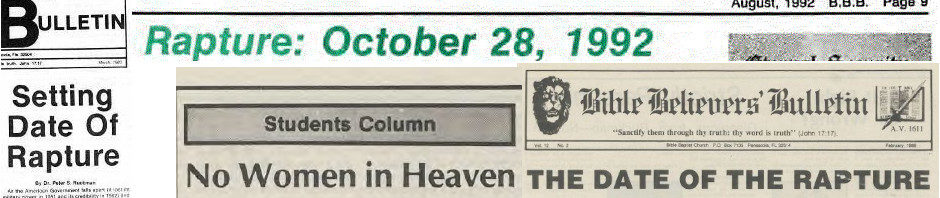
 One of Peter Ruckman’s views which is often rejected except by the most loyal of his followers is his teaching on “double inspiration.” The historic and biblical view is that inspiration took place once (over a period of time, as each canonical book was written), never to be repeated again once the canon was closed. Therefore the term “double inspiration” has the tendency to raise a red flag for many people, for good reason. Our experience is that many who otherwise tend to agree with Ruckman on Bible translations shy away from this controversial term.
We have presented the title to this article as a question because some questions remain about Ruckman’s position on the double inspiration of the KJV. If you disagree or if you have another explanation for Ruckman’s views on double inspiration, we welcome your respectful comments. We will start off with what is known and can be documented about his position.
We will allow Ruckman to explain his concept of double inspiration in his own words. The following summarizes his teaching on this matter in a concise manner:
What blank, freshman fool didn’t know that there are more than 150 quotations from the Hebrew Old Testament that pop up as a translation (the Greek New Testament) in every copy of the New Testament ever printed? The first time they were “inspired” was in the Hebrew language, and the next time (“double!”) they were inspired again in the New Testament “original autographs”! They were inspired in a different language, and many times the translations did NOT match “the original Hebrew” or the “original Old Testament manuscript” or “the Hebrew text.” ([No author listed, but bears Ruckman’s unmistakable style] Bible Believers’ Bulletin. Jan. 2008, p. 9)
Briefly, what Ruckman teaches is that since the Greek New Testament portions that originally come from the Hebrew Old Testament are inspired, we have a precedent for “double inspiration.” If the term “double inspiration” was used in that restricted sense alone, most Christians probably wouldn’t have a problem with the term. However, Ruckman uses this “double inspiration” argument as a springboard in an attempt to prove his view that Bible translating subsequent to the closing of the canon can be inspired. The problem is that he applies select translation work done uniquely by the Holy Spirit moving the writers (Hebrew to Greek of select portions) to routine translation (Bible versions). He tries to blur or overlook the distinction as if there were no difference between the Holy Spirit translating select Old Testament portions through the Biblical writers compared to fallible men translating the whole Bible without Holy Spirit inspiration. Ruckman also points out that when Hebrew portions appear in the Greek New Testament they are not always translated literally. Sometimes words are added or left out. He uses this to go a step further in pointing out that the KJV would not have to match the originals for it to be inspired. He therefore teaches or at least strongly implies that a legitimate case of double inspiration has occurred with the KJV.
This Holy Ghost type of translation that Ruckman is bringing into the picture was an extremely limited situation under which some statements in the New Testament as well as portions of Old Testament Scripture were translated uniquely under the inspiration of the Holy Spirit. This was to never happen again after about 90 A. D when inspiration ceased at the time the Scriptures were completed. Ruckman is bringing it up to be argumentative, to portray others as liars for saying that a translation cannot be inspired. Since in virtually every case that a believer states “a translation cannot be inspired” he is speaking in reference to Bible translating after 90 A. D., the believer is not being dishonest or disingenuous for saying this, as the unique internal translating under Holy Spirit inspiration can never be repeated. Ruckman is obfuscating, he is muddying the waters when he does this, and it demonstrates that he does not have a cohesive argument.
Ruckman also uses “reinspiration” and “secondary inspiration” as synonymous terms. Here is another quote from Ruckman’s perspective:
Third lie: “No translation can be inspired.” The liar has just denied more than 100 verses in the New Testament in any set of Greek manuscripts, from any “family,” in any time, by anybody, any place, anywhere. There are more than 100 quotations of the Old Testament in the New Testament, which were originally written in Hebrew and then TRANSLATED into Greek. If you say “no translation could be inspired,” you’ve thrown more than 100 verses out of the New Testament in all the manuscripts, including the “original manuscripts.” The “original manuscripts” of the New Testament were written in Greek, and their Old Testament quotations were TRANSLATIONS of the Hebrew. (Ruckman, Peter. “The Sound Mind.” Bible Believers’ Bulletin, May 2008, p. 14)
When non-Ruckmanites make statements to the effect that “translations are not inspired,” they do not do so with internal translations within Scripture in mind, as we do not know of any Christian whatsoever who teaches that the entire Bible is inspired in the originals except internally translated portions. Ruckman knows this, but on a technicality, he brands his opponents as liars and heretics in order to make himself look good:
Every Old Testament quotation in the New Testament is a translation of some other language. And if a “good, godly scholar” would lie about that —like all thirty-five in the above list did— he would steal your Bible, your church, your school, your ministry, and your faith … (Bible Believers’ Bulletin. Feb. 2000, p. 12)
… those who deny “double inspiration” are Bible-rejecting heretics … those who deny the inspiration of “any translation” are genuine heretics who have denied even the inspiration of the “original autographs” of the New Testament. (Bible Believers’ Bulletin. Feb. 1993, p. 10)
When the statement “no translation can be inspired” is made in theological discussions, in virtually every case it would be in the context of translations that were done since the Bible was completed. For Ruckman to accuse the person making the statement of being a liar is part of his unethical tactics. What Ruckman is doing is as unreasonable as accusing a person of being a liar for referring to an aircraft “black box” by its common colloquial name, even though in recent decades the color has changed to yellow or orange to make it easier to spot when searching a crash site.
It is likely that Ruckman came up with his double inspiration argument sometime after 1972, as it is not mentioned in his books The Bible Babel, (1964) The Christian’s Handbook of Manuscript Evidence, (1970) nor Satan’s Masterpiece: The New ASV (1972). Up till the early 1970’s, Ruckman said very little along the lines of the KJV being “given by inspiration of God” or inspired. This changed drastically with his double inspiration argument coupled with his new twist on interpreting 2 Tim. 3:16 later in the decade (See Ruckman’s self-serving interpretation for 2 Timothy 3:16).
Ruckman’s endorsement of a book teaching that the KJV was the third inspiration
One of the glowing endorsements in Ruckman’s Bible Believers’ Bulletin for a book by the title The New Athenians does not list an author for the endorser, but it is written in Ruckman’s characteristic style (Sep. 1992, p. 3). However, there is another promotion for the same book in the March 2008 issue which clearly lists Ruckman as the author of the endorsement. The book in question, written by James Son, is sold by Bible Baptist Bookstore as product KJ-1740. It states the following about “triple inspiration:”
I believe that the Authorized Version is the inspired, infallible, inerrant, immutable, pure word of God to English speaking people. (I not only believe in DOUBLE inspiration [which the NEW Athenians reject], but, also, I believe in TRIPLE INSPIRATION. I believe that God not only inspired the writers in the original languages, but also the New Testament writers when they TRANSLATED the Hebrew passages into the Greek, and the translators of the Authorized Version as they made their selection of English words.) (Son, James H. The New Athenians. Lubbock, TX: Praise Publishing, 1992, p. 25)
Ruckman declares that “the infallible Elizabethean English” is doubly inspired
Ah, the unsearchable riches of the infallible Elizabethean English! How profound are its revelations, and its “double-inspiration” past finding out! (No author listed, but it bore Ruckman’s unmistakable style. Bible Believers’ Bulletin, June 2006, p. 19)
Ruckman’s double inspiration is not so much a teaching as an argument. The teaching is that the KJV is inspired, and the double inspiration argument is only brought up in an attempt to refute the historical view that “a translation cannot be inspired.” He surfaces with this little-thought-of issue in order to confuse and catch people off guard who have not given much thought about the originals containing portions that are inspired but had been translated.
The problem with Ruckman’s argument is that he seems to want you to think that when a fallible man translates a Bible (after the closing of the canon about 90 A.D.) of which Ruckman approves, it is just as inspired as if the Holy Spirit had translated it. However, when a man translates a given word in the Bible, it is not God breathing out his word in the new language as when the Holy Spirit inspired Biblical writers. There are some God-breathed words in Greek and Hebrew that man may not be able to translate precisely without losing some of the nuances and implications of the original language. There is also the possibility of a man translating the wrong meaning when a given Greek or Hebrew word has many possible meanings. What the Holy Spirit can do flawlessly cannot be compared to what a man can do with all his limitations. Ruckman is aware of the fallibility of man in as simple a matter as copying manuscripts, but for this he suggests a novel way of sidestepping the issue: “A copyist can ‘miscopy’ a word and it still be INSPIRED.” (Ruckman, Peter. The Book of Psalms. Volume 1. Pensacola: Bible Baptist Bookstore, 1997 reprint, p. 127) The absurdity of this attempt to create his own self-serving illogical rules is beyond words!
While reading Ruckman’s books, we do not recall a case in which Ruckman stated outright that the KJV was an extra inspiration, but he strongly implies such by applying the double inspiration argument to those who say the KJV cannot be inspired. Adding to the complexity in the analysis of Ruckman’s views is that he at times denies what he seems to affirm about double inspiration of a translation: “We cannot claim direct inspiration in the original Biblical sense for the King James text…” (Ruckman, Peter. Theological Studies. Booklet 15, 1988, p. 15). This seems contradicted by the following, which implies a second inspiration occurred with the KJV: “The Holy Spirit has thrust Himself into the AV committee of 1611 and said, ‘WRITE…!'” (Ruckman, Peter. The Book of Acts. 1974, 1984, p. 356). Ruckman often makes statements along the lines of “Advanced revelation given by the Holy Spirit in the English text of 1611…” (Ruckman, Peter. The Book of Exodus. 1976, p. 186) and “an invisible hand on the Authorized Version” (Bible Believers’ Bulletin. Feb. 1996, p. 6) that reveal a belief in re-inspiration in 1611. That Ruckman openly endorses The New Athenians, which teaches outright that the KJV translators were inspired of God as they made their selection of English words (as documented earlier in this article), contributes to Ruckman’s view of double inspiration in the KJV.
When it comes to double inspiration, Ruckman wants to have it both ways. On one hand, when confronted, he sometimes seems to concede there was no secondary inspiration in 1611 akin to when the original manuscripts were written, yet he continues to use his “double inspiration” terminology and has not retracted any past writings on the topic. What Ruckman is doing lines up with a colloquial expression used in America, “he’s trying to have his cake and eat it too.” The fact that Ruckman has elevated and praised others who have taken his double inspiration to an extreme seems to indicate that Ruckman is disingenuous when he comes across as if he doesn’t believe that actual secondary inspiration took place in 1611.
There are many good people who claim not to hold to Ruckman’s double inspiration but teach that the KJV is inspired. My question for them is: If they do not wish to identify with Peter Ruckman, and if they do not believe that God breathed out the words of the KJV, and that the Holy Spirit did not inspire the KJV as he did the original manuscripts, why even state that the KJV is inspired to begin with? Why make such statements that are susceptible to misunderstanding? We believe that if they insist on using such terminology, they should explain in detail why their conclusions coincide with Ruckman’s (that the KJV is inspired) if they disagree with Ruckman’s double inspiration view.
Any internal translation in Scripture would have been a participant of the miracle of inspiration. Because there is a technicality in which internal translation within Scripture is inspired does not mean an instance outside that technicality can be inspired. No translation can be perfect absent a miracle.
When God breathes out words, they are inspired, regardless of whether those words in Greek match Hebrew Old Testament quotes or not. They are inspired because God himself breathed out the words in both languages. However, when human translators translate, the divine act of the Holy Spirit breathing out words does not take place. No double or secondary inspiration takes place when human translators do their work because they are not being inspired in the process as were the Biblical writers. We are not saying the Holy Spirit’s influence is totally absent, or that He is disinterested in translation, but his role is different than in the inspiration of the originals, and part of the evidence is how different Holy Spirit filled translators have reached different conclusions. This is evident in the differences between foreign translations based on the Masoretic Text/Textus Receptus and also Reformation-era Bibles in English before the KJV.
Ruckman proved there is translation within the Scripture itself that is inspired (because it contains internal translation, and “all Scripture is given by inspiration”), but that is not the same as proving the KJV itself is inspired, considering it was not given by inspiration as were the original manuscripts. This would be a fallacy known as hasty generalization. It no more makes the KJV inspired than it would the NIV or Bishops Bible. And if the Bishops Bible had been inspired, there would have been no need for the KJV, as the Bishops Bible came first.
Double Inspiration Part 2
Steve Somner of Lighthouse Baptist Indiana has posted in public domain a theory that he supports “double inspiration”.
See http://www.lighthousebaptistchurch.biz/index.php?p=1_56&nid=1#comments_top. Somner has taken several passages to conform to and idea of “double inspiration” but rather than work in his favor it works against him. In Somner’s mind, if passage in one testament is quoted differently in another we have double inspiration. This is suposed proving that Ruckmanism is correct i.e. the AV of 1611 corrects all the errors of both the Hebrew and Greek texts and those also in the received text. Somner being a four point Ruckmanite is not forward in defining “advanced revelation” within the fundamental theory. But more on this latter.
The attitude the foundation of the doctrine…
In general Somner likes to sling off and his apologetics as Ruckman’s is always prefaced by “trout mouthin’” then providing absolutely no comments upon the texts cited from the English AV 1611 translations or the texts themselves. Ruckmanism is well known for its public rudeness which characterizes it more than its teaching. In fact its fame is born of its mindset not its teaching. This indicates that the teaching is a cloak to be a “naughty boy” to be a “bully” full well knowing that righteous men tempered by the fruit of the spirit will not respond with the same gusto… However Somner as Ruckman both forget that though justified by faith we are mortal men in a body of death with earthly limits and one should not tick off a righteous man in the Spirit for he has nothing to loose.
The foundation attitude of Ruckmanism is Lucifarian and it is upon this foundation that the entire movement is built. Ruckmanism gains its reputation from this controversial approach the “naughty boy”, “the controversial star” seeking some attention tempting and denouncing any authority except its own. The error apologetically has been first to isolate attitude from the doctrine however the attitude is the teaching and cannot be divorced from it… The Apostle in his defense of the faith clearly attacks the mindset in advance of the doctrine, the Lord did likewise with the Pharisee understanding that the mind is not separated from what it teaches. It is from the abundance of the mind that the mouth speaks and the abundance of the mind of Ruckmanism is the gall of bitterness. This mindset is universal in serious serous Ruckmanites and it is plain that the apple has not fallen to far from the tree. Ruckmanism is a mind cult where control of the mind through discrediting any scholarship except their own deludes many and keeps others in the darkness of death, fear and superstition. In answering Somner as Ruckman we are most likely casting our pearls before swine however, we do this in order that those who sit under this ministry of death might be awakened to flee this court of Babylon’s cults.
Continuing
When challenged on this view of “double inspiration” in association with the text Somner insists that the explained figure of speech used in such cases to adequately explain differences in quotes i.e. the gnome, was of our invention. His response is quoted “You mention the gospel variations with a wide stroke of all being due to syntax, gnomes, and figures. It seems as if you are inventing your own catachresis as you go. “ The critique finishes with the following “Therefore, despite all the Greek grammar, that reveals nothing, God the author of Romans is revealing the hidden mysteries to his saints. Written a’ ONE a, a’ TWO a! Double inspiration” his quote is nothing more than ignorance of language and linguistics.
However for interested readers this figure can be found in the English bible as a quotation taken from its original sense a gnome or gonmee in the Greek meaning knowledge or understanding. The “gnome” is of the root “gnonai” meaning to know. There are 244 gnomes in the NT documents 147 agree in content while 97 differ in content, Somner’s ignorance could be passed over if his arrogance was not so invigorating and inviting well earned response. The entire batch of this figure is beyond the scope of this response but we include a few for the readers who wish to be further informed; Matt 1:23, Matt 15:4, Heb 9:8, Acts 28:25, Rom 9:17, the original sense is preserved in these internal gnomes… Matt 12:40, John 19:36, Eph 5:31-32, Gnomes where the original sense is modified…
Double inspiration is pre-suppositional apologetics where presupposition proceeds argument and if the Greek grammar reveals nothing “double inspiration” sits in a vacuum begging the question, “what comes first the chicken of the egg”. Logically a Ruckmanite cannot appeal to any of the texts for the 1611 edition of the AV, as these priori documents did not give rise to the postori translation… inspiration was the priori source f the 1611 AV. In the mind of a Ruckmanite the 1611 AV is a priori document not requiring any priori apart from itself… However without these priori documents there is no 1611 AV and consequently no argument. Ruckmanism is by default a moot point, self contradicting as it cannot escape it’s the postori nature in the translation of the 1611 AV…
In simpler terms it is like the “atheist” that must logically appeal to the priori of theism to define its “atheist” views… And like the atheist Ruckmanites hold the truth concerning themselves in unrighteousness…
We are indebted to the brilliance of Apostle Paul’s mind in exposing the real nature these arguments and Babylon’s Babblers… The sad fact is many are led to the second death under such teaching irrespective of the claims made by its “guru’s” … This fact alone should stir good men to action
We hope this stimulates more debate upon apologetical methods as it no point picking off the fruit one must go to the root of unbelief.
regards in Christ
Rabbi Ansel
Ruckman simply believes that the God who created the universe is still alive and is able it speak English and has given us a perfect inerrant bible fulfilling Ps. 12:6,7. If I believed what you do about God I would trade him in for a good pair of shoes, and get myself an honest job.
I am not a ruckmanite. I don't know much about him. But I believe he's right.
There is an error in the thought process of the writer of this article:
The problem with Ruckman's argument is that he seems to want you to think that when a fallible man translates a Bible of which he approves, it is just as inspired as if the Holy Spirit had translated it. However, when a man translates a given word in the Bible, it is not God breathing out his word in the new language as when the Holy Spirit inspired Biblical writers.
2 Peter 1:21 For the prophecy came not in old time by the will of man: but holy men of God spake as they were moved by the Holy Ghost.
If God could do it then, why is he unable to do that a second time? If God could do it from Hebrew to Greek, can't he do that from Hebrew and Greek to Spanish? To french? Perhaps by using holy men of God as they were moved by the Holy Ghost? Would that not be considered inspired by God? You don't think God can find holy men rather than fallable men for this purpose? He used them in the AV and he uses them today translating his word to many other languages. Not all languages today have a perfect bible, some don't have one at all, but there are holy men of God being moved by the Holy Ghost, working on it as you read this. You either have faith in his work, or you don't. God operates on holiness and faith. Without faith it is impossible to please him. Holy men is what the bible calls them. You call them fallable. Big difference. Please, read the verse again. The Holy Ghost is God and if he's involved, there's breath in it whether it happend once or otherwise.
I do agree with the writer, that if it is fallible man's own work, it is fallible. Christians must check the work done in their own languages and study it and test it in their own language for doctrinal errors. But these men must be led by the Holy Ghost in that process. Otherwise, it is not what the bible calls "prophecy" and "scriptures". In the end, the proof is in the fruit. If the work produces good fruit, it's good. But a corrupt tree doesn't put out good fruit. Doctrine is most important to keep.
1 Timothy 4:16 Take heed unto thyself, and unto the doctrine; continue in them: for in doing this thou shalt both save thyself, and them that hear thee.
Thanks for writing and sharing your concerns.
You wrote:
“2 Peter 1:21 For the prophecy came not in old time by the will of man: but holy men of God spake as they were moved by the Holy Ghost.
If God could do it then, why is he unable to do that a second time? If God could do it from Hebrew to Greek, can’t he do that from Hebrew and Greek to Spanish? To French?”
I agree with you, in that God is not unable to do this. “For with God nothing shall be impossible.” Luke 1:37. This is not impossible for God. The issue is–did God in his sovereignty actually choose to do this in other languages once His Word was complete? If He has chosen to do this, where is the evidence? Here are questions that need to be answered honestly before arriving at your conclusion:
Did Bible inspiration never end with the completion of Revelation?
Has there ever been a Bible translator that has testified to having been “moved by the Holy Ghost” in the process of his Bible translation work?
Can you point to Bibles translated in multiple languages that are even believed to be inspired? Can you list those languages? Do they match between them?
You wrote:
“…there are holy men of God being moved by the Holy Ghost, working on it as you read this.”
Can you name them? Would they agree with you if they were asked about this?
You wrote:
“Holy men is what the bible calls them. You call them fallable. Big difference.”
Even the “holy men” referred to in 2 Peter 1:21 were fallible men. “For all have sinned…” (Rom. 3:23). They were sinners saved by grace who walked with God whom He chose to use to write Scripture under inspiration. Bible translators can and should be saved by grace who walk with God and therefore holy, but since inspiration has ended they are not moved by the Holy Ghost. This partly explains why Reformation Bibles in English such as Tyndale, Coverdale, Geneva and Bishops do not match the KJV, and foreign translations based on the TR such as Diodati (Italian) Ostervald (French) Reina Valera (Spanish) Luther (German) Almeida (Portuguese) etc., do not match each other and the KJV, and have textual differences that are not always due to language variations. This does not make them unreliable and undependable. They produce good fruit, as you pointed out. They are the Word of God in their respective language even without having been translated under inspiration in the manner the original manuscripts were written.
Webmaster asks "where is the evidence?" that God inspired the KJV? PLEASE! LOL.
It HAS been PROVEN beyond any shadow of doubt that God inspired the KJV! Bill MacGregor PROVED it in his book The Tuning Fork, Periander Esplana PROVED it in his The Bible Formula, and Kevin Mann has PROVEN it time and again in his Number Nuggets In the King James Bible series of books. Michael Hoggard has also DOCUMENTED and PROVEN case after case where the KJV has textual and numeric phenomena that ONLY God could have inspired!
Only people like Webmaster are too dishonest, yellow, and cowardly to examine the AVAILABLE PROOF! They aren't any better in their attitude toward the translation and text of the Bible than your run of the mill Satanist and at the Judgment Seat of Christ, God is going to throw the Book at them and us Ruckmanite boys are gonna be there to see it!
I just named FOUR sources that PROVE that the Lord God Almighty inspired the text of the King James Bible! Breathe in the FIRE and feel the HAMMER Webmaster! Jeremiah 23:29 KJV!
If you indeed provide “absolute proof” I would join you in proclaiming it to the four corners of the earth, and it would resolve all sorts of textual disputes. But if what you offer is along the lines of 1611 constitutes 1+6+1+1=9–the number of perfection, therefore the KJV is inspired–or if you add together the first, third, and last letter of every verse of Numbers 16 you get KJVINSPIRED (I just made that up) or other similar silly schemes, it is neither scholarly, Biblical, nor convincing. Or if I have to spend $145 plus shipping for the three books you are promoting (one of them available in a set of 3 ebooks for "only [!!!] $100") to obtain evidence of what you call "PROVEN beyond any shadow of doubt," I'm out. This hardly sounds any different than writers selling books along the lines of "how to become a millionaire in 90 days" for $49. The reason it would be fishy is that in this hypothetical scenario, if the writer truly knew how to get rich quick, why is he resorting to writing and selling books, and if he is so rich why does he not just give away the information for free so we can all get rich quick together? If as you say, "it HAS been PROVEN beyond any shadow of doubt that God inspired the KJV" why should I have to send money to these writers to obtain the proof? Why not shout it freely from the housetops? Why not resolve the Bible version controversy for everyone once and for all with no financial obstacles in the way? I'm not against Christians selling books, but the way you are pushing these sounds like snake-oil salesman talk. You surely don't mean that, nor that my attitude toward the translation and text of the Bible supposedly isn't any better "than your run of the mill Satanist," so I encourage you to measure your words more carefully.
I do believe the KJV is accurate and trustworthy, and that is how sound translations have been viewed throughout history. The KJV is adequate and proven as a two-edged sword without any need for schemes to try to make it as if it was equal or even superior to the originals.