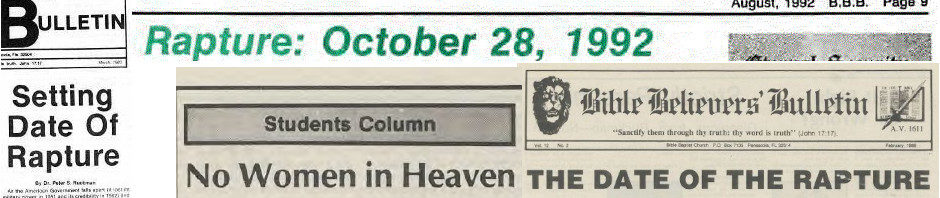
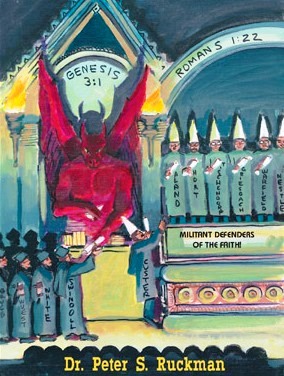
 Ruckman is proud of his “Creed of the Alexandrian Cult,” which is evident by his boasting that he has listed it in virtually every issue of the Bible Believers’ Bulletin since it was first issued in the 1970’s. He uses it to try to “prove” that those who do not follow his teachings on the KJV close enough are members of this “cult.” However, there are some inconsistencies in Ruckman’s position regarding the “creed” which we will attempt to demonstrate first.
Ruckman likes to include as many people he dislikes as possible in his fantasy of this so-called Alexandrian Cult, regardless of whether they strongly prefer the KJV or even if they use it consistently. Observe:
… Alexandrian Cult”). All the modern members of the cult (Shelton Smith, John R. Rice, Bob Jones Jr., Bob Jones III, Clarence Sexton … (Bible Believers’ Bulletin. June 2009, p. 5)
"…every "recognized" church historian and Christian "scholar" is a member of a CULT. This cult is the Alexandrian Cult of North Africa, and its tentacles stretch from Origen (184-254 A.D.) to John R. Rice and the faculty members of every "recognized" Christian school in the world. (Peter Ruckman, The Alexandrian Cult. Part One, 1978, p. 6).
The Alexandrian Cult stretches from Origen to Bob Jones, III, with a continual string of ‘high priests,” con-men, quick change artists, and neophytes. (Ruckman, Peter. The book of Minor Prophets Vol. 1 Hosea-Nahum. 1978, 1984 reprint, p. 152)
And the Alexandrian Cult has as many Evangelicals and Fundamentalists in it as it has Liberals and Neo-Evangelicals. (Ruckman, Peter. The book of Minor Prophets Vol. 1 Hosea-Nahum. 1978, 1984 reprint, p. 258)
Although without the designation “Alexandrian Cult,” Ruckman proceeded to label the following men as cultists:
Cultists…Matthew Henry…A.T. Robertson, Machen, Warfield, Robert Dick Wilson, Gleason Archer (Ruckman, Peter. The Minor Prophets. 1978, 1984, p. 466)
All members of the Alexandrian Cult are “cultists” and all follow “the creed of the cult.” (Bible Believers’ Bulletin Feb. 1994, p. 3)
In spite of Ruckman bragging about coming up with 100 new teachings, (Ruckman, Peter. Alexandrian Cult, Part Eight, 1981, p. 28) he does not believe it is right for others to label this new teaching we call Ruckmanism a cult (Ruckman, Peter. God is Love. 1998 reprint, p. 112). However, Ruckman does not treat others as he wants to be treated, and has even placed some KJV defenders he did not like or agree with (such as Bruce Lackey) in his fictitious “Alexandrian cult.” (Ruckman, Peter. King James Onlyism versus Scholarship Onlyism. p. 3)
Since such men as Hills and Burgon who Ruckman holds in fairly high regard in most of his writings did not believe the KJV or the Textus Receptus was inerrant, and by implication not the final absolute authority, they would also technically fall into Ruckman’s primary criteria for membership in his imaginary Alexandrian Cult. But he does not apply his Alexandrian Creed to them. Why this double standard? Could it be that he gives them a pass because they lived in an era in which when they began to write they did not “benefit” from Ruckman’s illumination? As to John Burgon, Sam Gipp interestingly admits: "Because he is so far in the past we Bible believers embrace him as a friend rather than an adversary." (The 2006 Geneva Bible: A Trojan Horse. 2008, p. 5)
Ruckman in all his writing has not shown explicitly what the final authority was between the time the originals passed off the scene and the emergence of the KJV in 1611. Ruckman demands a final authority that “anyone can read, teach, preach, or handle.” Therefore, by default everyone since the era in which the originals passed off the scene until people began to believe the KJV was the absolute authority would also have to be members of the Alexandrian Cult to remain consistent with Ruckman’s logic. It is common in foreign lands not to look upon a translation as the final authority, and many sincere believers in foreign lands who do not know English and have never even heard of the KJV, would technically fit Ruckman’s criteria for a member of this “cult.” Ruckman is clearly uncomfortable with the question of final authority for other languages and also for before 1611, calling those who dare ask about such matters “idiots.” (Ruckman, Peter. Bible Believers’ Bulletin Reprint #7 Strictly Personal. 2004, p. 243)
What follows is Ruckman’s “Alexandrian Creed” refuted point-by-point:
1. There is no final authority but God.
As to point number one in the “creed,” the conservative wing of those who Ruckman places in the category of the Alexandrian Cult believe that God provided a final authority in the form of the original manuscripts. They would believe something to the effect that God’s Word is an extension of His own authority, which is always final.
2. Since God is a Spirit, there is no final authority that can be seen, heard, read, felt, or handled.
3. Since all books are material, there is no book on this earth that is the final and absolute authority on what is right and what is wrong: what constitutes truth and what constitutes error.
Without the original manuscripts, Ruckman paints a bleak scenario unless we accept his teaching of a doubly-inspired, Greek-and-Hebrew-correcting, advanced-revelating translation over 1,500 years after Revelation was penned. Because Ruckman does not provide for a specific, tangible "final and absolute authority" during the large undeniable gap between the passing of the originals and the revealing of the KJV, his premise collapses and is shown to be based on a false line of reasoning.
However, before 1611 there was no sense of a lack of absolutes or authority, even though no translation was labeled a "final and absolute authority" (with a possible exception of the Latin Vulgate among some Catholics). The fact that believers before 1611 did not sense a lack of authority can be noticed in many of their writings on the Scriptures which have survived to this day. An example during this period is William Fulke, who died in 1589. He wrote A Defence of the Sincere and True Translations of the Holy Scriptures into the English Tongue, and Confutation of the Rhemish Testament. An example of no lack of authority can be detected in just one sentence: "The authority of the holy scriptures with us is more worth than the opinion of all the men in the world." (Fulke, William. A Defence of the Sincere and True Translations of the Holy Scriptures into the English Tongue. 1583, 1843; p. 523)
4. There WAS a series of writings one time which, IF they had all been put into a BOOK as soon as they were written the first time, WOULD HAVE constituted an infallible and final authority by which to judge truth and error.
In point four of the Alexandrian Creed, Ruckman tries to degrade the originals by making a big deal about the likelihood that the originals were never together in one book. However, it was not necessary for the various portions of Scripture to have been gathered into a single volume to become an infallible and final authority. Since Scripture does not contradict itself, each portion was infallible and the final authority alongside one another, even without all the portions being placed together in one volume. This question seems to be a diversionary tactic regarding a mere technicality.
5. However, this series of writings was lost, and the God who inspired them was unable to preserve their content through Bible-believing Christians at Antioch (Syria), where the first Bible teachers were (Acts 13:1), and where the first missionary trip originated (Acts 13:1-52), and where the word “Christian” originated (Acts 11:26).
In point five Ruckman accuses those (who are not in his camp) of believing that God is unable to preserve his Word. However, no Christian would believe that God is unable to do something (Luke 18:27), unless it was against his nature or his own Word. This statement is as unfair as would be accusing Ruckmanites of believing in a God who is incapable of providing a perfect Bible printed without typos or unable to translate the Bible into all the languages of the world. The disagreement for many is not whether God promised to preserve his Word or was unable to do it, but rather the specific details of the method, extent and location of preservation. Good people disagree on the specifics. No one to whom Ruckman applies this “creed” would agree with point five as written, except possibly some modernists.
6. So, God chose to ALMOST preserve them through Gnostics and philosophers from Alexandria, Egypt, even though God called His Son OUT of Egypt (Matthew 2), Jacob OUT of Egypt (Genesis 49), Israel OUT of Egypt (Exodus 15), and Joseph’s bones OUT of Egypt (Exodus 13).
On point number six, as to God “almost” fulfilling his promise, no thinking Christian would use such terminology. As mentioned previously, the disagreement for many is not whether God promised to preserve his Word or was unable to do it but rather the specific details of the method, extent and location of preservation.
Although we do not favor Alexandrian manuscripts which are predominantly from Egypt (where the dry climate helped ensure its survival), we always considered the argument that we should avoid anything related to Egypt (because of how the country is frequently portrayed in the Bible) to be unscholarly. The logic behind this runs as follows: Since the majority of Alexandrian manuscripts come from Egypt, and the Bible refers to Egypt mostly in negative terms, this proves that we should not trust what comes from Egypt. However, many references to Syria, the country where Antioch is located, are negative in the Bible. So if we follow the same logic that was applied to Egypt, it would fall apart when applied to Syria. This logic seems childish, and aimed at the naive who don't think for themselves. A determination on the complex matter of the manuscripts must be based on data and an analysis of the facts and not on geographical bias or logic that does not follow sound rules of Biblical hermeneutics.
7. So, there are two streams of Bibles: the most accurate—though, of course, there is no final, absolute authority for determining truth and error: it is a matter of “preference”—are the Egyptian translations from Alexandria, Egypt, which are “almost the originals,” although not quite.
Ruckman has slanderously placed several in his imaginary cult who have taken public positions contrary to translations based on Alexandrian manuscripts being “most accurate” or “almost the originals” (such as Shelton Smith, Clarence Sexton, and Bruce Lackey). Also, most who study Greek New Testament manuscripts believe in more than two manuscript “streams” or text types.
8. The most inaccurate translations were those that brought about the German Reformation (Luther, Zwingli, Boehler, Zinzendorf, Spener, etc.) and the worldwide missionary movement of the English-speaking people: the Bible that Sunday, Torrey, Moody, Finney, Spurgeon, Whitefield, Wesley, and Chapman used.
On point number eight, Ruckman has the members of the "Alexandrian Cult" believing that Reformation Bibles are less accurate than modern translations. It is true that those of us who believe that those Bibles from the Reformation era based on the Textus Receptus are more accurate than modern Bibles are in the minority today, but Ruckman places some who hold to that minority belief in his Alexandrian Cult. This shows that among other reasons already mentioned, some whom he unfairly places in this "cult" disagree with most points of this “creed.”
9. But we can “tolerate” these if those who believe in them will tolerate US. After all, since there is NO ABSOLUTE AND FINAL AUTHORITY that anyone can read, teach, preach, or handle, the whole thing is a matter of “PREFERENCE.” You may prefer what you prefer, and we will prefer what we prefer; let us live in peace, and if we cannot agree on anything or everything, let us all agree on one thing: THERE IS NO FINAL, ABSOLUTE, WRITTEN AUTHORITY OF GOD ANYWHERE ON THIS EARTH.
Ruckman’s Creed of the Alexandrian Cult culminates with the following sentence often in capital letters for effect: “THERE IS NO FINAL, ABSOLUTE, WRITTEN AUTHORITY OF GOD ANYWHERE ON THIS EARTH.” No thinking conservative Christian would use such choice of words to describe the present situation–in which the original manuscripts are no longer with us–without clarification. Even though we do not have the final authority in our midst in the form of the original manuscripts, we have an adequate authority derived from them. If that were not the case, the KJV translators could not have been able to produce their work. Ruckman in all his prolific writings has not told us specifically where the “final, absolute, written authority of God” was between the time the original manuscripts passed off the scene and 1611. Could it be that everyone during that time belonged to what Ruckman calls “the Alexandrian Cult?”
The biggest weakness in Ruckman’s continual designation of the term “final authority” for the KJV is its technical meaning. Final authority means exactly that; final. It means nothing can supersede or replace it. If the KJV is the final authority, it would mean there was no final authority before 1611. To believe in the KJV as the final authority would actually mean that the original manuscripts were not the final authority, because a true final authority can never be replaced. It is true that the KJV is a more practical authority for English speakers (because of its availability and the language it’s in), but to designate the KJV as the final absolute authority is to demean the original manuscripts and the sources the KJV translators used in their translation.
Whether Ruckmanism meets the definition of a cult may be a matter of dispute, but the remarks of Ruckman as documented here in which he places even some defenders of the KJV in this imaginary Alexandrian Cult betray at the very least an isolationist “us versus them” mentality, which is cultic.
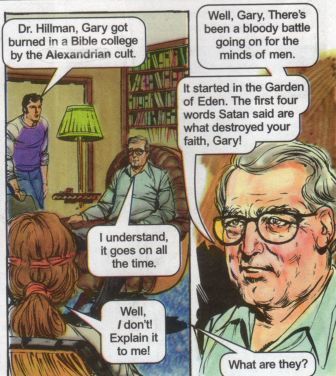 Ruckman invented the "Alexandrian Cult" fantasy, but others have used the concept. This is from Jack Chick's comic Sabotage?
Some people are to smart for their own good. What about using your own critical analyism on yourself?
Do you understand Dr. Ruckman's reasoning ? Do you understand why he believes it may be important to teach that there is a trusted copy of God's Word?
Do you think there is a difference in a person's heart and mind if when he reads a Bible that he believed it may or may not be God's Word vs. a sure assurance that it is?
To Ruckman the bottom line is not whether a person believes they have a trusted copy of the Word of God. That is a ruse you have apparently fallen for. He has even placed a defender of the KJV in his “Alexandrian Cult,” namely Bruce Lackey, author of “Why I Believe the Old King James Bible” and “Can you Trust your Bible?” (he answers in the affirmative). Ruckman even called Lackey an “elitist tradesman from the Alexandrian Cult.” (Ruckman, Peter. King James Onlyism versus Scholarship Onlyism. p. 3)
“Do you think there is a difference in a person’s heart and mind if when he reads a Bible that he believed it may or may not be God’s Word vs. a sure assurance that it is?”
Yes. But Ruckman wants you to go further than that. If you don’t believe his nonsense that the KJV contains advanced revelations, corrects the Greek and Hebrew, is superior to the originals, etc., and you dare warn others about him he will label you a cultist.
Mr Davis, I must object! Do you comprehend Ruckmanite reasoning? Ruckmanism REJECTS the Almighty-inspired word and words of God for the Authorized Version, a magnificent version the noble translators claimed NO INSPIRIATION, and NO CREED ever until the 1950s called. Ruckman's 1964 book did not claim his later inspired, advanced revelation views (and other cultic, insane, inane doctrines). If nobody but Ruckman in documented church history claimed any translation after the close of the canon, it makes him a heresiarch! By rejecting the immidately inspired Aramaic, Hebrew and Greek words in the Bible coallated and preserved in the Great Second Rabbinic Bible as well as the Traditional Text, Ruckman rejected sola scriptura. Therefore, any truth he may have said is undermined by his manifold heresies, even the very intergity of the sacred text! This means that though he stated there is a copy, he actually rejected the words God gave, for which the blood of saints and martyrs from Abel to Zacharias and beyond spills. Do YOU understand Ruckman rejected the Bible for a baseless theory?
NO BAPTIST EVER beleived what Ruckman espoused! Consider these three examples–
1) The Philadelphia Confession
2) The 1693 Baptist Catechism
3) Gadsby's Catechism.
I believe the KJV is better than the originals because the originals no longer exist, were in two languages most of the world can't even read or speak, and Dr. Ruckman pointed out MANY instances where the KJV does in fact contain translations that have modern significance that you just cannot get in the Hebrew or Greek! I don't know if anyone should call those "advanced revelations", but they are there!
There is an element of truth in that a translation in one’s own language is more practical than a foreign language original that is no longer in existence. So in this limited restricted understanding a translation can be in a sense “superior” to the original. Kind of like the idiom “a bird in the hand is worth two in the bush.” However, as applied to upholding the KJV over modern translations there is a massive flaw in this argument. Using the same line of thinking, a modern version proponent can say “My modern version in English is superior to the originals because for me it is readable and obtainable, unlike the originals.” It is such a flawed argument that it is hardly ever used by those who uphold the KJV outside of Ruckman’s circle.
Concerning Ruckman’s advanced revelations in the KJV, he makes the following claims, among other things:
Often Ruckman restricts his advanced revelations to the KJV:
With that in mind, notice the following example of a claim of advanced revelation by Ruckman:
I like the term Calvary, which is a beautiful word in English. But to be technical, in English it does not reveal its meaning or any new truth not in Greek. How could this be an advanced revelation? If the term Calvary was an advanced revelation as Ruckman says, would we have to resort to the KJV for it? To test Ruckman’s claim, I examined the 1599 Hutter Polyglot, which Gail Riplinger affirms “demonstrates the perfect agreement of the English King James Bible with all pure Bibles from other languages.” At Luke 23:33 the Italian Bible in 1599 Hutter Polyglot has “Caluario,” and the English has “Caluarie.” So much for Ruckman warning that “You must resort to the infallible AV (1611) text for an advanced revelation found in NO Greek manuscript.”!!!
I totally agree with your points brother! In fact, I would like to add that the KJV translators also relied on the Latin Vulgate readings many times (for 'Lucifer' for example, as well), and could have easily used the term Calvary from there.
I have also found that MANY, MANY of Dr. Ruckman's arguments and writings actually damage the defense of the King James Bible, rather than help it. We must rely on the Lord's discernment to stay away from faulty and erroneous apologetics!
Thanks for pointing out the danger in using arguments for the KJV that can backfire when the same arguments can be used by modern version proponents. That is something I think Dr. Ruckman had a hard time grasping. The strong defence of the KJV says we believe it because it is supported by the majority of the underlying Hebrew and Greek texts. It's just sad that most modern Christians are painfully unaware of the difference between pure Hebrew and Greek texts, as opposed to the impure, such as some of the Dead Sea scroll manuscripts and the Minority texts.
Please don't get me wrong. I am definitely NOT as against Dr. Ruckman as much as yourself, and I for one thank our Lord Jesus Christ that I learned so much from the man (even if it was what not to do or how NOT to talk to people) and that his ministry helped me grow in the Lord. BUT, we definitely must recognize what is scriptural truth versus a man's flawed opinion, and my reliance and trust is in the Lord and His scriptures first and foremost. I loved Pete Ruckman dearly, but have to part company with the man, or any man for that matter, where they are at odds with the King James Bible!
Thank you Webmaster, for your commitment to truth and our Lord!
I Kings 18.21; II Chronicles 19.2, Mr Beck.
That Ruckman called the mighty Puritan Matthew Henry part of the cult when he quoted none but the Traditional text and Second Great Rabbinic Bible, saving the occasional quotes from the Targums, Syriac, LXX ad nauseam (so did Trapp, Poole, Gill, Ryle, Spurgeon, Benson, Clarke, Whendon, Calvin and on). Here is his comments on I Peter's opening chapter. For Ruckman to call one of the brightest Christian minds ever a part of a cult is the embodiment of folly!
Proverbs 30:10 Mr. de Bryus
Oh! And 1 Peter 3:16 Mr. de Bryus!
I do not deal with those who use pretexts to excuse away heretics, and those that seem rather than composing their thoughts make sporadic posts, which in itself is unwise. I have a project for three scholars and three books to write, including one on the history of the SBC from a Strict Baptist standpoint, seeing as they broke from us starting in the 1750s. On their falling away alone could one easily write several volumes, so I way to you, Mr Beck, with The Preacher,
The beginning of strife is as when one letteth out water: therefore leave off contention, before it be meddled with.
"Even though we do not have the final authority in our midst in the form of the original manuscripts, we have an adequate authority derived from them."
What is "adequate authority"? Where do you get the other parts of the authority to make it a full authority?
Adequate authority is what we had before Ruckman’s time, it is what is available today for those who know no English, it was available before the KJV translators were born, and it was even available before the first edition of the Textus Receptus. Ruckman’s “final authority” is extremely convenient for English speakers after 1611 like you, who don’t have to learn a new language in order to have the privilege that supposedly only English speakers have. But Ruckman’s “final authority” becomes unreachable for those unfortunate souls who died before 1611 or who cannot speak English. When applied to real-life situations of foreign speakers, or retroactively to the past before 1611, Ruckmanism’s logic and consistency disintegrates into utter absurdity.
Believers were not wringing their hands because of a lack of an adequate authority before Ruckman’s foolishness. Here is an example written in reference to Bible translations in 1658:
“For the originals, though we have not the primitive copies written by the finger of God in the tablets, or by Moses and the prophets in the Hebrew, or by the apostles, and the rest in the Greek for the New Testament, yet we have copies in both languages, which copies vary not from the primitive writings in any matter which may stumble any. This concerns only the learned, and they know that by consent of all parties, the most learned on all sides amongst Christians do shake hands in this, that God by his providence hath preserved them uncorrupt. What if there be variety of readings in some copies? and some mistakes in writing or printing? This makes nothing against our doctrine, since for all this the fountain runs clear, and if the fountain be not clear all translations must needs be muddy. (Richard Capel, Capel’s Remains, 1658, pp. 19-20)
“It’s no paradox to hold, that a thing not infallible, may by way of ministry lead us to that certainty which is infallible.” (Richard Capel, Capel’s Remains, 1658, p. 73)
Here is an example from 1659:
“Thirdly, we add that the whole Scripture entire, as given out from God, without any loss, is preserved in the copies of the originals yet remaining; what varieties there are among the copies themselves shall be afterward declared; in them all, we say, is every letter and tittle of the word. These copies we say, are the rule, standard, and touchstone, of all translations, ancient or modern, by which they are in all things to be examined, tried, corrected, amended, and themselves only by themselves. Translations contain the word of God, and are the word of God, perfectly or imperfectly, according as they express the words, sense, and meaning of those originals. To advance any, all translations concurring, into an equality with the originals, so to set them by it, as to set them up with it, on even terms, much more to propose and use them as means of castigating, amending, altering any thing in them, gathering various lections by them, is to set up an altar of our own, by the altar of God, and to make equal the wisdom, care, skill, and diligence of men, with the wisdom, care, and providence of God himself.” John Owens, Integrity and purity of the Hebrew and Greek text of the Scriptures, p. 461
The following is from a writer Ruckman praised:
“But I would especially remind my readers of Bentley’s golden precept, that ‘The real text of the sacred writers does not now, since the originals have been so long lost, lie in any MS, or edition, but is dispersed in them all.’ This truth, which was evident to the powerful intellect of that great scholar, lies at the root of all sound Textual Criticism.”
The Traditional Text of the Holy Gospels, Volume I, 1896, by John William Burgon, page 26.
If you want an example before 1611, William Fulke, who died in 1589, wrote Confutation of the Rhemish Testament in a debate over the Bible with a Catholic. He did not lack an adequate authority before 1611.
For my thoughts are not your thoughts, neither are your ways my ways, saith the LORD. Isa. 55:8